Bucephalandra (Buce) care guide
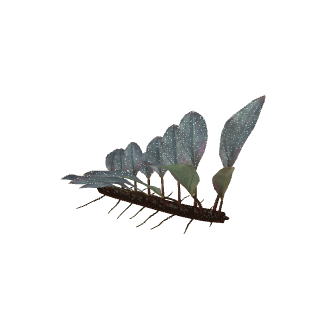
Bucephalandra spp. · Araceae
Bucephalandra (Bucephalandra spp.) is an aquatic plant. It belongs to the Araceae family. It is native to Endemic to Borneo (most species in Indonesian Kalimantan, others in Malaysian Sarawak/Sabah and Brunei); forms mats on rocks in and beside fast forest streams. It needs low to medium light. Water temperature: 20°C – 26°C. pH: 5.5 – 7.5. Care difficulty: Easy. Growth rate: slow.
How do you care for Bucephalandra (Buce)?
| Light | Low to Medium (grows under subdued light; stronger light brings more colour but invites algae on the slow leaves) |
|---|---|
| CO₂ | Optional (low demand; CO₂ helps growth) |
| Temperature | 20°C – 26°C |
| pH | 5.5 – 7.5 |
| Placement | Wedge into rock crevices or driftwood foreground/midground; suits nano tanks |
| Growth | Slow |
| Difficulty | Easy |
| Family | Araceae |
How do you trim and propagate Bucephalandra (Buce)?
Remove old, dirty or algae-covered leaves and clear debris from the clump — keeping it clean is the main long-term job; it branches on its own without trimming. Propagate by cutting the rhizome (pieces longer than about 4 cm, shorter for tiny forms) or separating side shoots and tying them onto hardscape.
What problems affect Bucephalandra (Buce)?
Buce melt — leaves turn translucent and drop soon after purchase, as farm-grown emersed plants switch to submerged growth or after sudden parameter changes; algae on the slow leaves under too much light or with debris build-up; rhizome rot when buried.
How do you fix Bucephalandra (Buce) problems?
Keep the rhizome: remove dead leaves and hold conditions stable — new submerged leaves grow from it. Lower the light, clean away debris and add grazers; attach the rhizome above the substrate and cut away soft tissue.
Where does Bucephalandra (Buce) come from?
Endemic to Borneo (most species in Indonesian Kalimantan, others in Malaysian Sarawak/Sabah and Brunei); forms mats on rocks in and beside fast forest streams · Biotope regions: South-east Asia.
What should you know before buying Bucephalandra (Buce)?
Much trade stock has been wild-collected in Borneo, raising over-harvesting concerns — prefer farmed or tissue-culture plants. Not recorded as weedy or naturalised anywhere.
Sources
- Bucephalandra — Wikipedia
- Bucephalandra – Aquarium and Pond Plants of the World — USDA APHIS / idtools.org (APPW)
- Synthesis of Bucephalandra Schott studies in Kalimantan, Indonesia: checklist, key and distribution maps — ResearchGate (peer-reviewed article listing; abstract via search)
- Bucephalandra pygmaea 'Wavy Green' — Tropica
- Bucephalandra sp. 'Braun-rot' ('Serimbu') — Flowgrow Wasserpflanzen-Datenbank
- Bucephalandra motleyana — Flowgrow Wasserpflanzen-Datenbank
- How to grow Bucephalandra — The 2Hr Aquarist
- Care Guide for Bucephalandra — Aquarium Co-Op
Care details checked against these sources on 2026-09-23.
Which aquascapes and tanks use Bucephalandra (Buce)?
- Balancing light, CO₂ and fertiliser in a planted tank
- Jungle aquascape: plants, layering and setup
- Nature Aquarium style: layout rules and setup
- Paludarium: how to build a half-land, half-water tank
- Riparium: a riverbank tank with plants above the water
- Wabi-kusa: how to make and grow an emersed plant ball
See Bucephalandra (Buce) in a living world
- Riccardia Shrimp Cave — aquarium
- Rocky Mountain Waterfall — paludarium
- Wild Sound — aquarium
- Ha Long Bay Miniature — aquarium
- Betta Nano — aquarium
- Betta Sorority — aquarium
Last updated · Open the interactive 3D guide · All species care guides