Blue Blubber Jelly (Catostylus) care guide
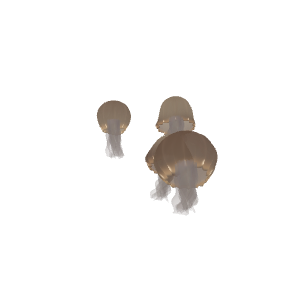
Catostylus mosaicus · Catostylidae
Blue Blubber Jelly (Catostylus mosaicus) is an aquarium animal. It belongs to the Catostylidae family. It is native to Coastal eastern and northern Australia (Sydney Harbour, Moreton Bay). Lives in estuaries, semi-enclosed lagoons and shallow bays, mostly in higher-salinity water; rapid salinity changes impair its osmoregulation.. Water temperature: 22°C – 26°C. pH: 8.0 – 8.4. Care difficulty: Moderate.
How do you care for Blue Blubber Jelly (Catostylus)?
| Light | Medium light: the bell holds fewer zooxanthellae than other rhizostomes, so ordinary LED or white light is fine. Colour ranges from white and light blue to purple, maroon and brown. |
|---|---|
| Temperature | 22°C – 26°C |
| pH | 8.0 – 8.4 |
| Placement | Purpose-built jelly tank (pseudokreisel or cylinder), bare and cornerless, with a large screened outflow. Salinity 32-35 ppt. Keep flow gentle and as low as possible; it is a strong swimmer and needs open water. |
| Growth | Grows fast. Wild bells are about 25-35 cm (up to 40 cm in one source); captive animals are usually much smaller. Lives about 13 months in the wild and up to about 1 year in aquaria. |
| Difficulty | Moderate (needs a dedicated, well-managed jelly system and steady food) |
| Family | Catostylidae |
How do you trim and propagate Blue Blubber Jelly (Catostylus)?
Do matched partial water changes, test ammonia, nitrite, nitrate and salinity regularly, and siphon debris and clean screens so the active swimmers are not pinned. Feed enriched Artemia nauplii, copepods and small zooplankton once or twice daily. Breeding: medusae release planulae that settle as polyps; polyps bud and strobilate, releasing stacks of fast-growing ephyrae.
What problems affect Blue Blubber Jelly (Catostylus)?
Pitted, deformed or inverted bell: bubbles, poor flow or stress. Pinned on the screen or overflow: flow mismatch or poorly placed screen. Sinking or floating after a water change: salinity mismatch causing osmotic stress. Lethargy and weak pulse: heavy metals such as copper or zinc.
How do you fix Blue Blubber Jelly (Catostylus) problems?
Remove bubble sources, lower flow and check water quality. Widen the screen and adjust flow to a gentle gyre. Match salinity and temperature before refilling, and change water slowly. Find and remove copper or zinc sources and use clean water. Acclimate new animals slowly.
Where does Blue Blubber Jelly (Catostylus) come from?
Coastal eastern and northern Australia (Sydney Harbour, Moreton Bay). Lives in estuaries, semi-enclosed lagoons and shallow bays, mostly in higher-salinity water; rapid salinity changes impair its osmoregulation.
What should you know before buying Blue Blubber Jelly (Catostylus)?
Sting is mild and irritating rather than dangerous, but sensitive people can react, so wash hands after handling. It is native to Australia and no source consulted reports it as invasive; still, never release jellies, polyps or tank water into the sea, drains or waterways. Suits keepers with a dedicated jelly system and temperature control; not for a regular fish tank or anyone unable to supply steady zooplankton food.
Sources
- Jellyfish (Cnidaria & Ctenophora) Care Manual, 3rd ed. (ch. 1 water quality, temperature, acclimation, bubbles, ch. 5-6 and species list) — Association of Zoos and Aquariums (AZA)
- Catostylus mosaicus — Wikipedia
- Jelly Blubber facts — SEA LIFE Sydney Aquarium
- Recruitment and growth of Catostylus mosaicus medusae (Pitt & Kingsford 2003) — Marine and Freshwater Research (CSIRO)
- Maroon Blubber Jellyfish (product care data) — Quality Marine
- Jelly blubber — Oceanografic Valencia
- Blue blubber jelly — National Aquarium (USA)
Care details checked against these sources on 2026-10-07.
See Blue Blubber Jelly (Catostylus) in a living world
- Blue Blubber Cylinder — aquarium
Last updated · Open the interactive 3D guide · All species care guides